Americans with disabilities work remotely more than the general population in these states
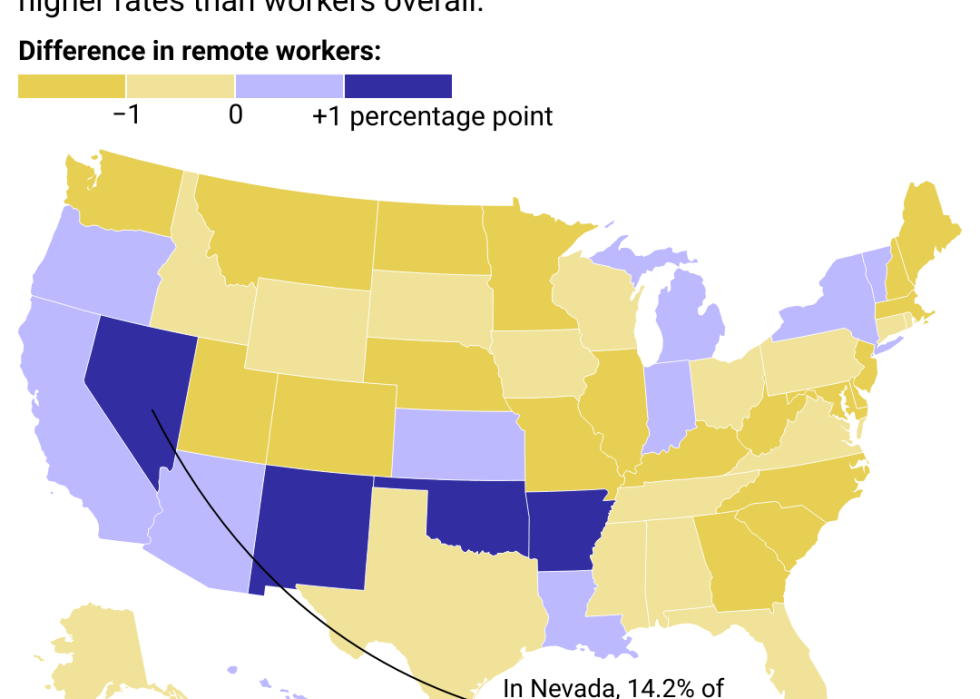
The remote work wave has not reached workers with disabilities equally across the nation.
In most states, a smaller share of workers with disabilities have remote jobs compared to the rate for workers overall. In Colorado, North Carolina, and the District of Columbia, which have some of the widest gaps, remote work rates for all workers and those with disabilities surpass national averages—quite substantially in the latter two. Workers with disabilities also have higher workforce participation rates in Colorado and Washington D.C., potentially meaning more workers in nonremote-capable roles.
However, in 13 states, workers with disabilities have remote jobs at higher rates than workers overall. The difference is small in most cases but stands out in a few. In Nevada, workers with disabilities lead the overall working population in remote jobs by 2.6 percentage points. Workers who report having disabilities in New Mexico, Oklahoma, and Arkansas also work remotely at notably higher rates.
Interestingly, these states' overall work-from-home rates are lower than the national average. In these cases, remote access at work may be limited and potentially reserved for those with accessibility needs. For instance, in Nevada, the state government issued new guidance in December 2023 specifying that for agency employees, "remote work is the exception, not the rule." The rule provided that remote work agreements would be approved individually and not applied across entire departments, divisions, or other broad categories—limiting remote opportunities for workers overall.
While this particular guidance only applies to state government workers, it reflects a broader working culture that is less remote-friendly. Meanwhile, allowing individuals with disabilities to work at home is one type of reasonable accommodation, which the Americans with Disabilities Act requires employers with 15 or more employees to make. In turn, remote work remains a viable option for employees with disabilities as an exception to otherwise tightening restrictions.
Importantly, not all workers with disabilities want remote jobs or work in roles suitable to be done beyond the workplace. Working remotely can cause isolation and loneliness, impacts that could be particularly detrimental to those with disabilities, who already face disproportionate stigma and exclusion in social settings.
Still, remote work offers myriad benefits for workers with and without disabilities alike. It can potentially promote equity and inclusion—especially when executed with the proper tools, practices, and normalization, rather than treated as a one-off accommodation.
Story editing by Carren Jao. Additional editing by Kelly Glass. Copy editing by Paris Close.