Americans today are as divided on the value of public education as they are along party lines
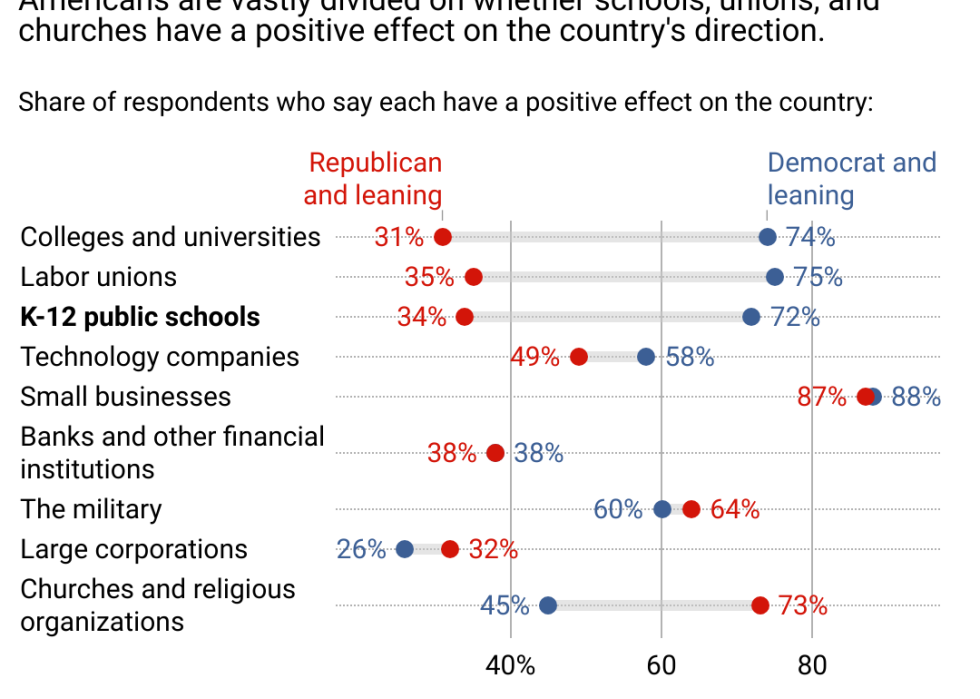
Apart from education, Pew's January 2024 national survey also measured how American adults viewed the impacts of a broad spectrum of institutions, including the military, small businesses, labor unions, technology companies, large corporations, banks and financial institutions, and churches and religious organizations.
The partisan divide between Democrats and Republicans on both K-12 and higher education is most closely mirrored in their views on labor unions, followed closely (and inversely) by churches and religious organizations.
Labor unions have long been seen as supporters of the Democratic Party. According to a 2023 Pew survey, about 3 in 5 (59%) voters lean Democratic. Historically, union influence has advocated for social security, health insurance, and even the concept of weekends. In the 1950s, 1 in 3 private sector workers belonged to unions, according to political economist Margaret Levi. By 2021, that figure dropped to 1 in 16, partly aided by Republican-backed "right to work" laws that have effectively shrunk unions. Trump's reelection also bodes for more pro-business policies that would make it more difficult for workers to unionize.
However, according to the Center for American Progress, there is a resurgence of union interest, bolstered by Gen Zers. Strikes and strike threats in the last few years have secured workers gains in wages, especially in parcel delivery, health care, and education.
Conversely, about 3 in 4 (73%) Republican or Republican-leaning respondents viewed churches and religious organizations positively versus just 45% of Democrats and Democrat-leaning respondents. Many religious voters have mostly been drawn to the Republican party, Matthew Wilson, a political scientist and associate professor at Southern Methodist University, told Spectrum News. "So now, looking at someone's level of religious commitment tells you more about their likely partisan allegiance than just about anything else you could know." This applies most to white voters, he added.
Despite many areas where Americans differ across party lines, they do agree on the impact of some institutions. Both Republicans and Democrats were overwhelmingly supportive of small businesses, at 87% and 88%, respectively. While adults in both parties are more closely aligned on their feelings about institutions like the military, there is less overall support from both. Adults from both parties align with the view that banks and large corporations are negatively viewed.
Regardless of their political leanings, dismantling the DOE would have far-reaching consequences for many Americans. Federal programs like the Public Service Loan Forgiveness and Income-Driven Repayment could be eliminated, along with vital funding and oversight for programs that support an estimated 75 million public school students with disabilities.
Story editing by Carren Jao. Copy editing by Sofía Jarrín. Photo selection by Ania Antecka.