America's college-aged population is declining. Universities will have to make cuts.
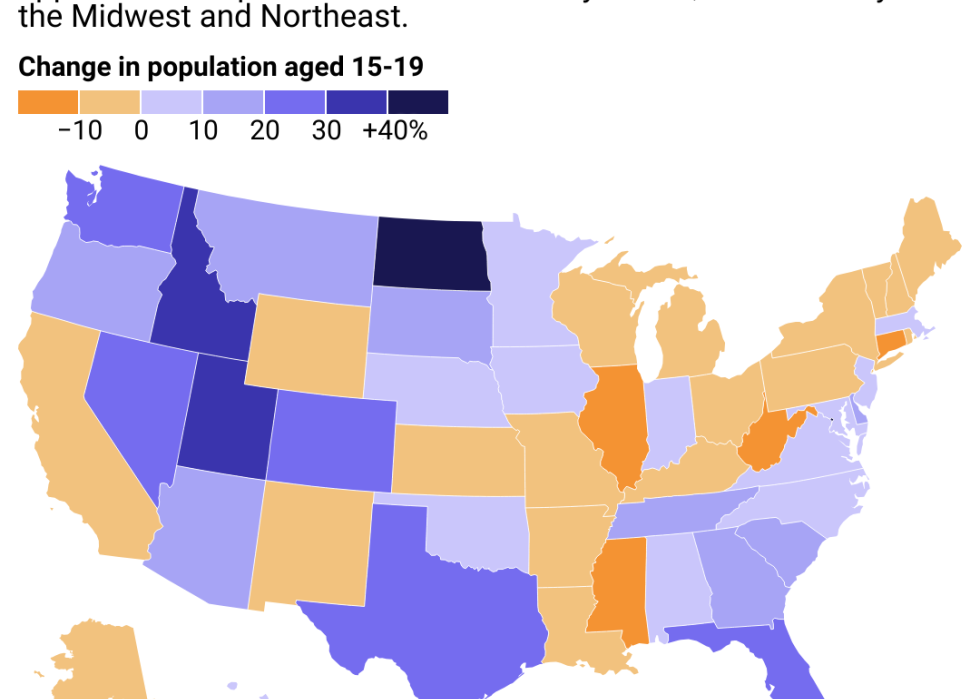
America's population is getting older, with the number of people aged 75 to 79 anticipated to grow by 44.7% by 2050, a July 2024 Cooper Center study found. The demographic of those aged 80 to 84 is expected to grow by 81%, from 6.3 million in 2020 to 11.5 million in 2050.
However, the population projection found that the number of anticipated college-aged students is expected to decline in many states nationwide in the coming decades. The Department of Education, on the other hand, anticipates the number of high school graduates will decline by 7.5% by 2031.
Although the total population of college-aged students is expected to increase by 6% to around 23.3 million by 2050, the figure pales in comparison to the anticipated 12% increase in the overall population of the United States during the same time period, the study found.
The slowing rate of growth among college-aged students is expected to have the greatest impact in regions like the Northeast and Midwest, where states like Connecticut (-14.4%), Illinois (-16.6%), and West Virginia (-18.6%) are each expected to experience double-digit population declines by 2050.
Conversely, the cohort of college-aged students is expected to increase in the Southeast in states like Florida (24.5%) and Georgia (15.3%) and in Mountain West states like Colorado (25.2%) and Nevada (24.8%) that have more remote populations.
Public universities and smaller schools, particularly those that aren't centers of research or athletic powerhouses, may also be at risk.
Some universities have already recalibrated in light of enrollment declines and budget cuts. In Pennsylvania, the state redesigned its university system by consolidating institutions, creating two regional universities out of six existing universities in the western and northeastern parts of the state. Enrollment has declined in these areas in recent decades, with more students opting to enroll in online classes instead of living on campus.
While some smaller colleges and universities with consistently declining enrollment might be at risk of closing in the coming years, the elimination of programs could be the biggest change in American institutions, according to a report by the Brookings Institute.
Public universities in states where growth among young people is expected to slow or decline will likely be the hardest hit by the demographic trend, with some already making cuts.
West Virginia University announced it was cutting around 5% of faculty positions and dropping 28 of its majors as the state university grapples with a $45 million budget shortfall and a 10% decline in enrollment since 2015, the Associated Press reported.
Deep cuts also were made at St. Cloud State University, one of the largest schools in Minnesota, where full-time student enrollment has dropped by more than half since 2010. The university made drastic budget reductions to its music department among cuts to 42 majors, eliminated its football team, and reduced its faculty by 54 members.
Whether large or small, college towns across the country often serve as hubs of employment in the area. Closures or drastic cuts to the institutions that anchor these towns will likely harm the local economies.
Only time will tell how higher education will fare amid drastic shifts. Amid ongoing demographic changes, cuts will likely continue for the foreseeable future.
Story editing by Alizah Salario. Additional editing by Kelly Glass. Copy editing by Paris Close. Photo selection by Ania Antecka.