As college enrollment declines, interest in these majors is growing for the 2024-25 school year
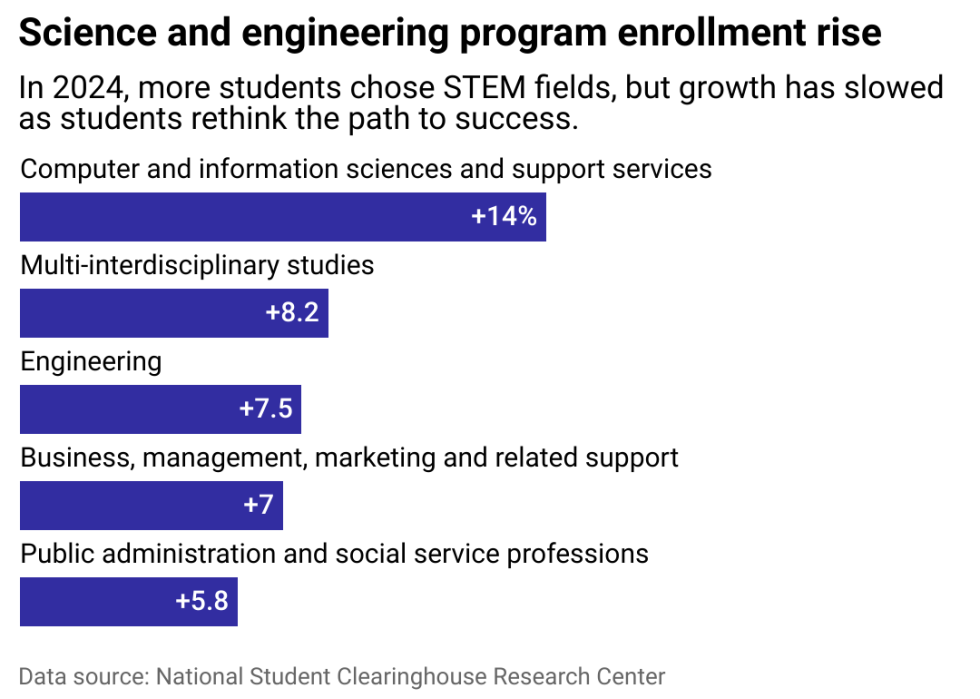
While college enrollment has slowed, Eric Greenberg—president of the New York-based consulting firm Greenberg Educational Group—insists that professional and science, technology, engineering, and math fields still dominate. Compared to last year, these fields showed gains mainly because of the higher earning potential of STEM graduates. Academic trends often mirror shifts and priorities in public life and societal issues, such as the surge in physics majors during the Cold War. Each shift tells a story, revealing how students navigate an uncertain future.
Increased interest in computer and information sciences reflects the ongoing demand for tech-savvy professionals. However, the National Student Clearinghouse Research Center notes the growth in computer science college programs has plateaued compared to previous years, potentially signaling market saturation or a reevaluation of tech job stability amid widespread layoffs in the sector.
Multi-interdisciplinary studies and engineering have also seen substantial growth. This may point to students gravitating toward flexible, integrative skills that apply to emerging industries. Engineering, in particular, remains a cornerstone for addressing global infrastructure challenges and climate change, reflecting a long-term focus on problem-solving professions.
The steady growth in business, marketing, and management majors highlights the enduring importance of entrepreneurial and leadership skills in a rapidly evolving economy. As industries adapt to technological advancements and global competition, students are drawn to fields that equip them with versatile, in-demand expertise.
Programs in social services and public administration are gaining traction. These fields align with pressing issues like social justice, sustainability, and crisis management, which are of major significance to today's youth.
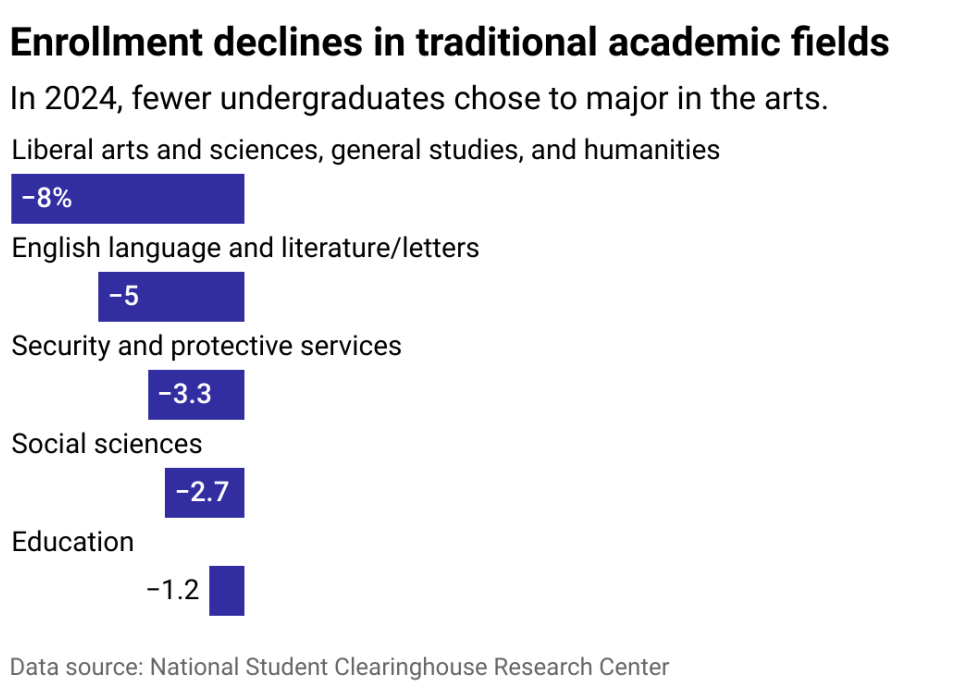
Declines in traditional humanities majors point to skepticism about their return on investment, driven by economic pressures, uncertainties, and ballooning student loan debt. Students and their families increasingly hesitate to invest in fields with less clear career trajectories.
Liberal arts and English literature programs have experienced steep enrollment drops, reflecting their weaker earning potential than STEM and business fields. According to the Georgetown University Center on Education and the Workforce, graduates in STEM and business majors earn a median salary of $60,000 to $65,000 within five years of graduation, significantly higher than the $40,000 median for humanities graduates.
Universities have begun responding to students' fluctuating career choices by integrating practical skills into liberal arts curricula, such as those in digital humanities or interdisciplinary programs. However, these changes may not be competitive enough in an era when students increasingly prioritize financial stability.
Similarly, interest in security and protective services has declined. They may not align with the broader aspirations of younger generations, who often prioritize social impact and environmental sustainability in their career choices and potential income. Jobs in the security industry can offer a sense of meaning, but they are also physically demanding, sometimes dangerous, and often involve long, irregular hours. They may also offer low pay and repetitive tasks.
Declining enrollment in teaching programs also highlights systemic issues in the country's education. Teachers often face lower pay, rising workloads, and limited support from public officials, leading to burnout and a nationwide teacher shortage. Without significant reform, these challenges risk further eroding interest in the profession, potentially eroding the broader educational landscape.
Careers, however, are rarely straightforward, and no matter how much one charts their course in advance, they are likely to shift with the winds of the time.
Story editing by Alizah Salario. Additional editing by Kelly Glass. Copy editing by Sofía Jarrín. Photo selection by Ania Antecka.