Why salary isn't solving teacher turnover: Survey finds work-life balance key to retention
While compensation is still essential, work-life balance has emerged as a pivotal factor. Pew Research Center found that 54% of teachers say it's hard to achieve a work-life balance. Further, the Study.com survey reveals that 43% of teachers considering leaving would reconsider if they had a better work-life balance.
Echoing these results, a RAND Corporation study shows that teachers report higher stress levels than any other professional group, with many citing insufficient planning time and the burden of non-teaching tasks as key issues. These factors, compounded by a lack of in-class support, create a challenging environment for educators.
Beyond the Paycheck: In-Class Support
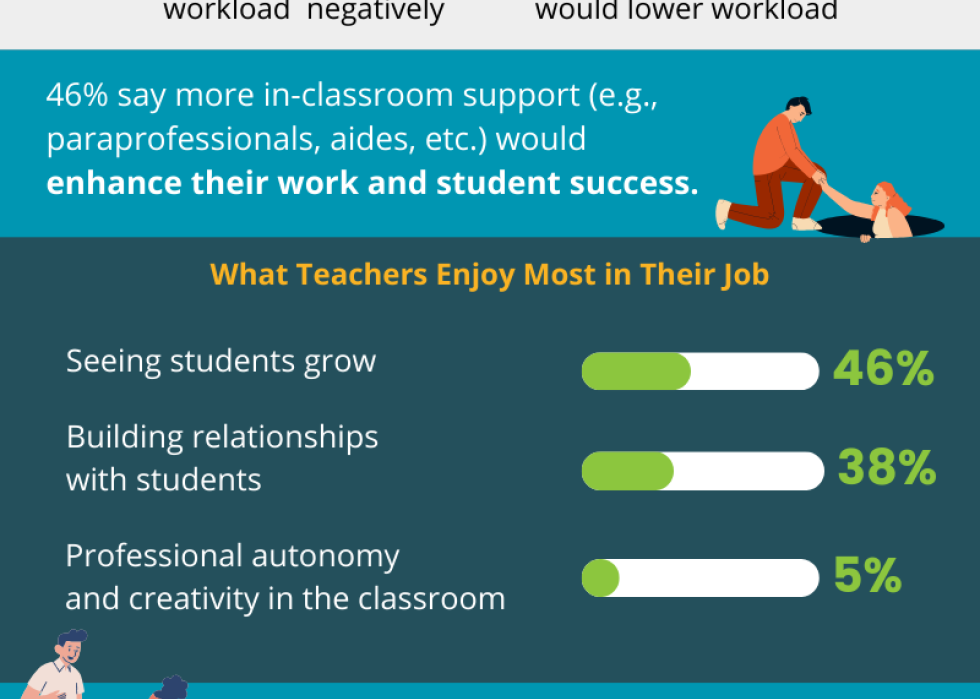
Speaking of in-class support, Study.com also found that 46% of teachers believe more support in the form of paraprofessionals or aides would improve both their work experience and student outcomes.
84% of teachers report having too much work to get done in an average workday. Paraprofessionals and other forms of in-class help could alleviate this burden.
Unfortunately, only 30% of schools have paraprofessionals available frequently. This lack of in-class support is critical, as research from the National Education Association indicates that classroom aides can help reduce teacher stress and improve student engagement.
Challenges Beyond Salary: Student Behavior and Administrative Load
Managing student behavior and parental expectations is still a significant hurdle. Gallup found that 42% of teachers do not feel respected. Meanwhile, the Study.com survey found that 54% of teachers are stressed by classroom management and behavior issues, a finding in-line with recent studies by the American Psychological Association, which reports increased classroom disruptions in post-pandemic schooling environments. Furthermore, 52% of teachers say they lack adequate training to handle disruptive situations, highlighting a need for more support in behavior management.
Another major pain point is the administrative load. Roughly 28% of teachers in the Study.com survey identified excessive paperwork as a top source of dissatisfaction, especially in states like Florida, where the figure rises to 40%. This reflects findings from the Brookings Institution, which found that 55% of teachers who left the profession in 2022 cited inadequate administrative support as a contributing factor to their departure.
Inclusivity and the Need for Belonging
Schools that foster a sense of inclusivity see higher teacher satisfaction. Half of the teachers in the Study.com survey reported that a greater focus on inclusivity would improve their job satisfaction.
For teachers of color, this figure is even higher, with 59% of Black teachers and 63% of Asian teachers stating that increased inclusivity would boost their satisfaction. Research from the Albert Shanker Institute echoes these findings, demonstrating a positive correlation between inclusive school climates and teacher retention.
Regional and Racial Differences in Teacher Satisfaction
Regional and racial differences in teacher satisfaction reveal a more nuanced picture. Study.com found that Black teachers are generally more satisfied with salary and growth opportunities than their White and Hispanic/Latino peers, with 59% of Black teachers expressing satisfaction. Nationally, 63% of Black teachers are also more likely to feel supported by school administration, compared to 35% of White teachers.
On a regional level, 30% of teachers in California report low job satisfaction, while Texas and Florida have higher satisfaction rates. Teachers in Texas, Pennsylvania, and California cited administrative workloads as a major stressor, with dissatisfaction highest in Texas (57%).
Currently, only 29% of Black, Indigenous, and People of Color teachers report being "very likely" to remain in the classroom for their entire career.