GOP cuts to Medicaid could threaten rural hospitals
The loss of that federal money would be especially hard on rural healthcare providers, Cochran-McLain said. That's because a greater share of the rural population relies on Medicaid compared to urban and suburban areas.
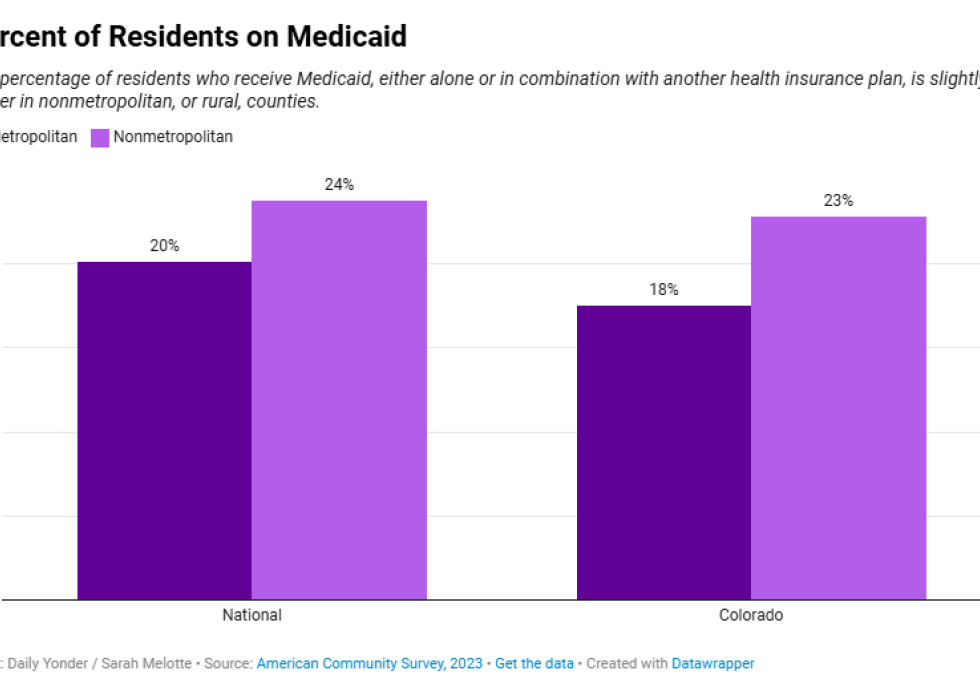
Nonmetropolitan, or rural, counties have slightly higher Medicaid enrollment rates than metropolitan counties. Nationwide, 24% of residents in rural counties received Medicaid either alone or in combination with another health insurance method in 2023, compared to about 20% of the metropolitan population that year.
In Colorado, 23% of the nonmetropolitan population and 18% of the metropolitan population received Medicaid in 2023, according to a Daily Yonder analysis of Census data.
Of the 47 states that have nonmetropolitan counties, 43 of them have higher Medicaid enrollment rates in rural areas compared to metro ones.
"There is a really direct and strong relationship between Medicaid coverage levels and the financial viability of rural hospitals," Cochran-McClain said. "In states that have expanded Medicaid, we saw an improved hospital performance, rural hospital performance and smaller rates of vulnerability for rural hospitals."
Expanding Medicaid to include more low-income individuals saves states money by reducing the cost of providing care to the uninsured.
States that have not expanded Medicaid leave their rural healthcare systems more vulnerable to financial crises.
"Whether it's Medicare or Medicaid, it's a really important revenue source and source of coverage," said Cochran-McClain.
How Does Medicaid Work in Colorado?
Colorado lawmakers voted to expand Medicaid coverage in 2009, ahead of implementation of ACA. The state simultaneously created a hospital provider fee program that funds the state's portion of Medicaid. In Colorado, the federal match rate comes to 63.6%. The hospital provider fees pay the rest.
Many states use provider taxes or fees to fund Medicaid programs at the state level. Colorado taxes hospitals and healthcare providers 5.5% of revenue (the fee cannot exceed 6%) with a program called the Colorado Healthcare Affordability and Sustainability Enterprise (CHASE). That money is then matched by the federal government at 90%, as long as the population falls under the ACA expansion eligibility.
Colorado's CHASE funds go to offsetting the difference between Medicaid reimbursement and the actual cost of a service. Medicaid typically reimburses a provider around 50% of cost, said Tom Rennell, senior vice president of financial policy and data analytics for Colorado Hospital Association.
Rennell said that CHASE "helps out our rural hospitals more than our urban hospitals. Our rural hospitals pay in less fees and our rural hospitals receive more of the distribution."
Increasing taxes and fees from healthcare providers are one funding source that could help bridge the gap if federal funding is cut, said Rennell.
In Colorado, the state legislature has a constitutional requirement to have a balanced budget. That budget is currently facing a $1.2 billion deficit, some of which is caused by rising Medicaid costs. Colorado's Taxpayer Bill of Rights (TABOR) restricts government spending to population growth plus inflation, meaning that any additional tax revenue over that formula is returned to taxpayers.
This means that even if the state has the revenue to balance the budget, it's incredibly difficult to reallocate those funds to other programs, like Medicaid. Colorado voters have historically been very protective of TABOR refunds. Raising taxes to fund Medicaid is also not an option in Colorado under TABOR.
"The state's already wrestling with a billion dollar shortfall in our upcoming year, and then add onto that potential additional shortfall from this federal funding. And those really start to add up to some real sizable impacts that the state is going to have to deal with," said Rennell.
The Colorado Hospital Association estimated that federal Medicaid cuts could cost the state $27.2 billion over the next five years, depending on specific cuts.
Rennell sees the potential cuts affecting rural hospitals disproportionately. "This funding from the federal government is their lifeline. It is what keeps those rural hospitals operating. And if you cut the lifeline, they will have to make difficult choices."
This story was produced with support from the LOR Foundation. LOR works with people in rural places to improve quality of life.