How Iowa is spending federal infrastructure dollars
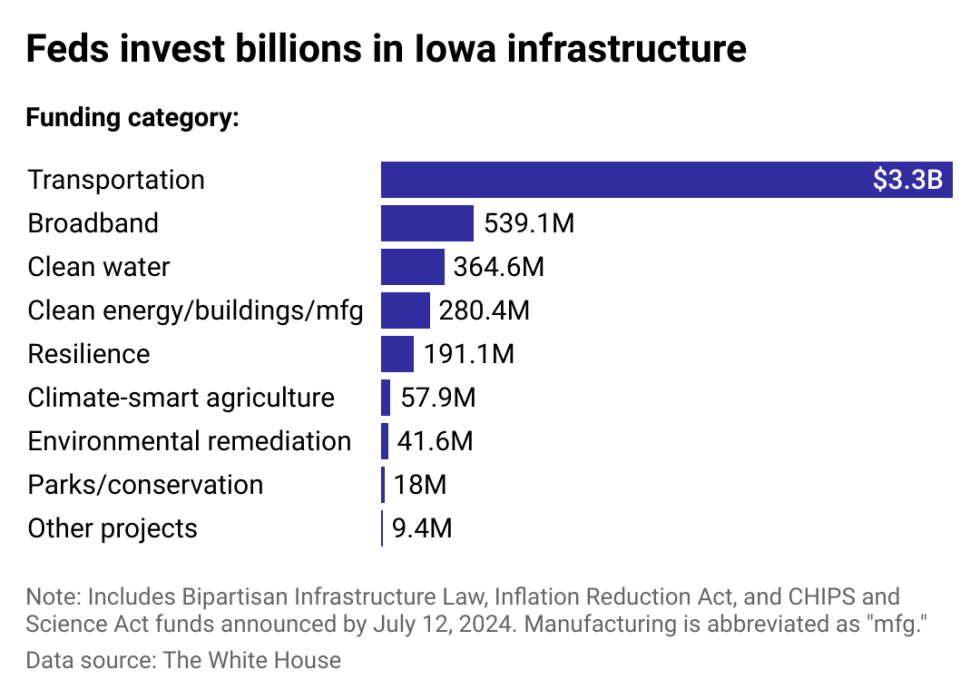
The federal government has announced $4.8 billion in funds toward Iowa infrastructure projects. Most of these funds are going toward transportation projects, at 68.7%, which this analysis will cover more thoroughly in the next section.
Unsurprisingly, Polk County received the most federal funding in the state at $171.5 million—though that only includes projects where White House data specified the county, leaving out billions of dollars across hundreds of projects.
Some of the largest non-transportation projects in Iowa were funded through the Broadband Equity, Access, And Deployment Program; the Home Energy Performance-Based, Whole-House Rebates; the High-Efficiency Electric Home Rebate Program; and others.
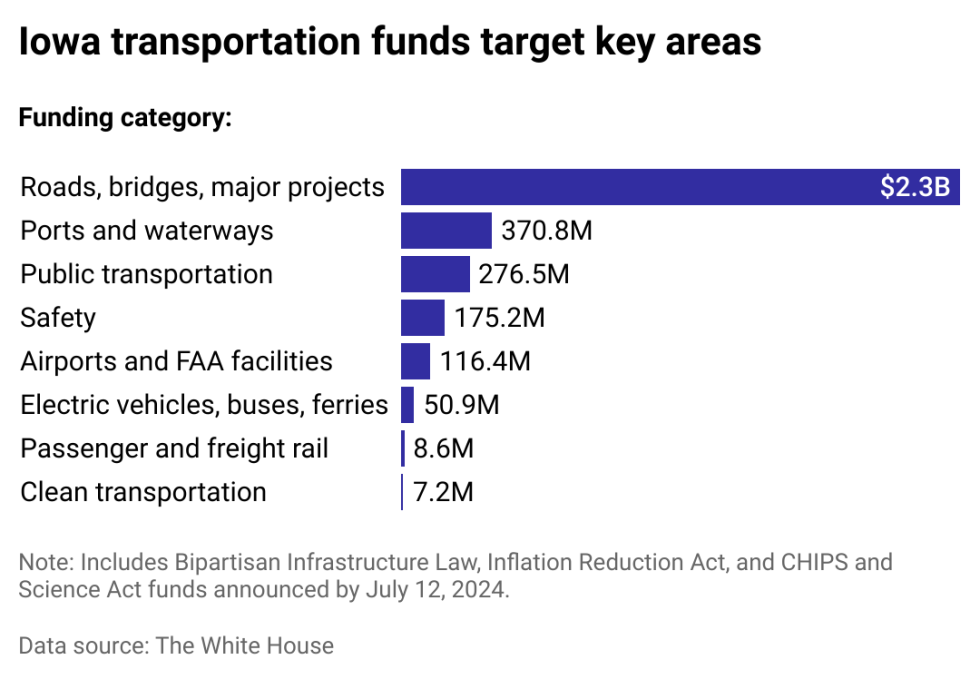
Transportation projects dominate overall infrastructure funding allocations, according to the data. Just over half of federal dollars announced so far are geared toward transportation projects across the country. Within the category, most funding has been doled out to build, repair, or modernize roads, bridges, and other major projects. The same is true in Iowa, where 69.5% of transportation funds are going toward these.
Some initiatives, like the National Highway Performance Program and National Electric Vehicle Infrastructure Formula Program, provided specific allocations to states to invest in broad categories. Others were awarded through applications for more specific expansion or repair projects. A few of the large titled projects in Iowa include:
- $316 million in Operation and Maintenance (No-Year) funding for the Missouri River - Sioux City To The Mouth
- $57 million in Rural Surface Transportation Grant Program funding for the I-380 & Wright Brothers Boulevard Freight Hub
- $34 million in Nationally Significant Freight and Highway Projects (INFRA) funding for the Southeast Connector SE 30th to US 65
This is a snapshot of allocations as of July, but new projects are announced every couple of weeks. With so much funding going into the nation's infrastructure, residents are likely to encounter working crews and new features wherever they travel—whether driving, by plane, on public transit, or otherwise—for years to come. Lawmakers hope that these efforts will modernize the nation, enhance safety and resilience, all the while creating jobs and boosting American industries.
This story features data reporting and writing by Paxtyn Merten and is part of a series utilizing data automation across 50 states.