How long do New Year's resolutions actually last?
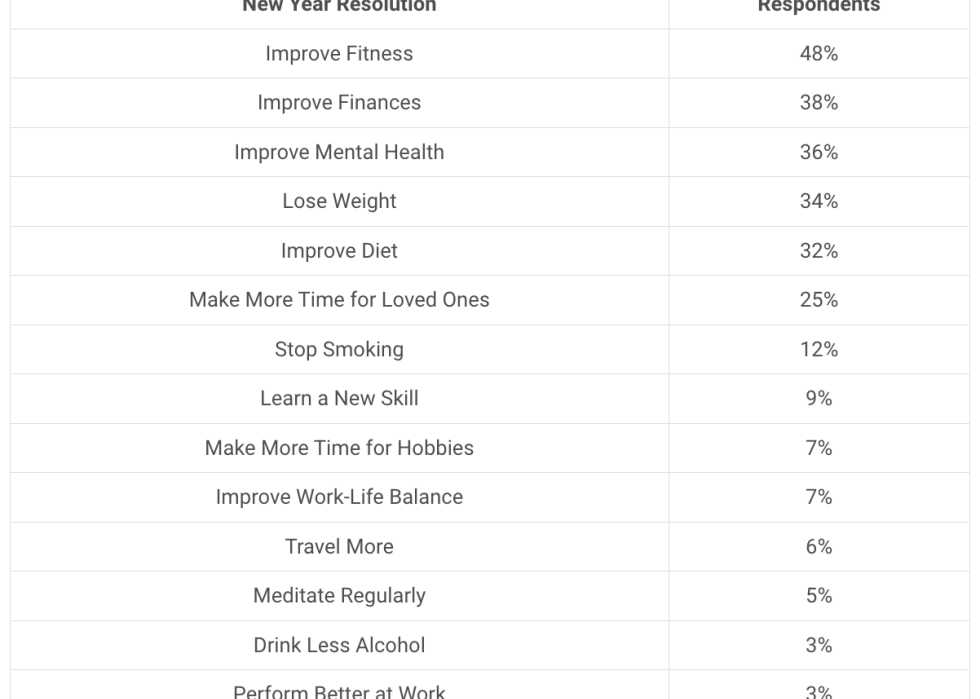
To answer this, return to the findings of the Forbes Health Survey and examine the most popular New Year's resolutions for 2024.
As can be seen, there are goals that can be achieved instantly and goals that take time. For instance, you can decide to stop smoking today and commit to this instantly. However, to lose weight, you need time, patience, and a lot of consistency. If these goals are divided further, the results look something like this:
Short-term goals
- Improve diet
- Make more time for loved ones
- Stop smoking
- Learn a new skill
- Make more time for hobbies
- Travel more
- Meditate regularly
- Drink less alcohol
Long-term goals
- Improve fitness
- Improve finances
- Improve mental health
- Lose weight
- Improve work-life balance
- Perform better at work
From these metrics, what's certain is that people who prioritize short-term goals over long-term goals have more chances of hitting their goals. People with long-term goals as their New Year's resolutions need to stay patient and consistent for longer durations.
When they don't see results, chances are they will drop off from their New Year's resolutions.
Reasons Why Most New Year's Resolutions Fail
There are a few similarities in the many surveys and research on how long New Year's resolutions last. On a deeper analysis, what becomes clear is that most New Year's resolutions fail for a few common reasons. Activewear brand Sundried did a study on why most New Year's resolutions fail and came up with the following ten reasons why most resolutions fail:
- Going solo
- High expectations
- Giving up too easily
- Not enough time
- Not enough money
- No plan
- No motivation
- No self belief
- Social situations
- Forgetting
One of the most interesting observations and reason for most New Year's resolutions failing is forgetting the goal. Yes, as much as people might hate to accept it, some New Year's resolutions are made when they're celebrating the New Year with a drink in one hand.
Setting unrealistic New Year's resolutions is also a leading factor for most failed resolutions. Instead of focusing on things that can be achieved, many people overstride and set the bar too high, resulting in an uphill climb.
Why Are Resolutions So Hard to Keep?
The main problem with New Year's resolutions is that they are a concept most people do because of how mainstream they have become. If you genuinely want to change something, you should never have to wait for the calendar year to keep flipping until the end of December.
Going back to the numbers shared in the Forbes Health Survey and a summary report by Inside Out, most resolutions lack motivation. Instead, they are driven by an urge to start the new year fresh. People consider the beginning of a new year as a clean slate that enables them to focus on new goals.
However, the urge to change and set goals at the start of a year is immediate but usually starts fading by the end of January. If the resolutions were driven by change, more than a social trend, fear of missing out, or peer pressure to do so, chances are more likely for a person to stick with a New Year's resolution.
Wrapping Up
At the end of the day, if people decide they actually want to commit themselves to the New Year's resolutions they set in 2025, things will look very different than the numbers shared here. If people continue the same dedication they had in 2024, the numbers will remain the same. After all, changes need to start with you. If your goal is "New Year, New You," start today instead of waiting for Jan. 1.