Who's hiring on H-1B? Here are the US metros and companies with the most visa holders.
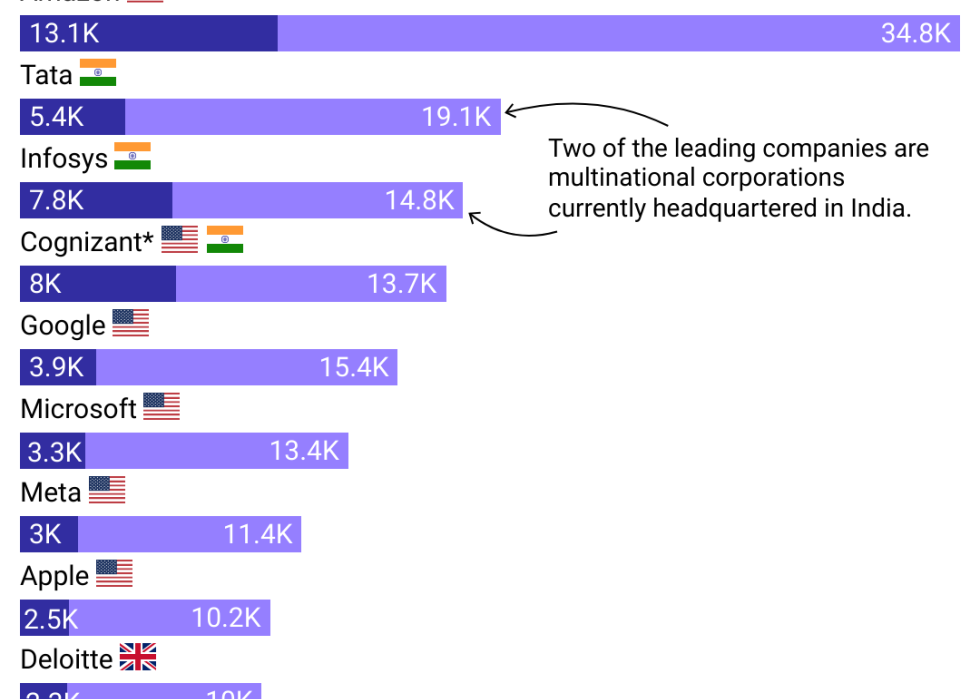
Silicon Valley tech companies have become closely associated with the H-1B program, and the data supports this connection. In 2024, analysis of USCIS data shows approximately 1 in 5 of these visas—both new applications and renewals—were issued in California. Of these, about half were sponsored by companies located in Silicon Valley.
Notably, 3 of the 5 top H-1B visa sponsors are either Indian companies or U.S. companies with strong connections to India. This aligns with broader data showing that in 2022, Indian-born nationals received 72.6% of these visas, with most working in science, technology, engineering, and mathematics fields. The next most common country was China, which trailed in second place with 12.5% of the share of these visas.
This concentration from India has raised concerns about potential program abuse, particularly by large IT firms. Last year, more than 20 former employees of Tata Consultancy Services filed complaints with the Equal Employment Opportunity Commission, alleging discrimination favoring Indian workers, reported The Wall Street Journal. In 2013, Infosys, an Indian company, paid a $34 million civil settlement over allegations of systematic visa fraud and abuse of immigration processes. More recently, a federal class-action lawsuit found Cognizant, a U.S. company with an Indian arm, guilty of intentionally discriminating against non-Indian employees.
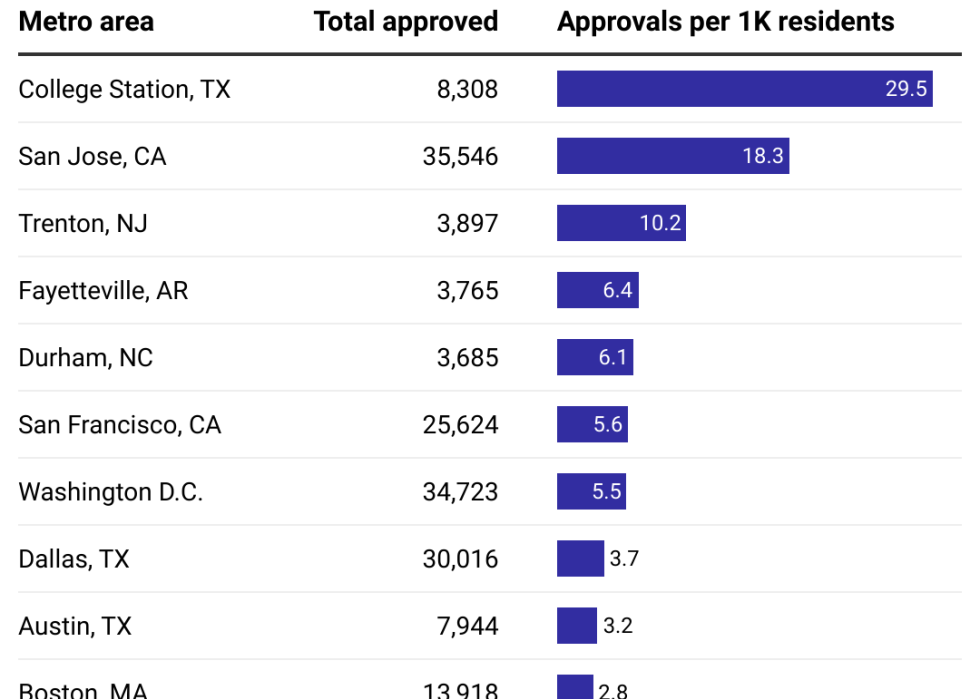
Among the tech hubs with the highest concentration of H-1B visas are metros in the San Francisco Bay Area. San Jose comes in at #2 (home of Google, Apple, and NVIDIA) and also has the second-largest overall number of approved visas after New York. The San Francisco metro area (home of Meta, Salesforce, and Uber) came in at #6.
The presence of Indian IT companies drives up the presence of H-1B visa holders in other areas as well. In particular, the area with the highest number of holders—almost 30 per 1,000 residents—is College Station, Texas, where the large majority of these visas derive from Cognizant's presence. The same is true for Dallas, where the main employer of H-1B visa holders is Infosys. Tata Consultancy shares the Washington D.C. metro area with Amazon. Together, the two companies sponsor more than 20% and 40% of the visas, respectively.
Concerns over H-1B visa changes aimed at reducing approvals have alarmed tech companies and raised anxiety among Indian nationals pursuing career opportunities in the U.S., the BBC reports. Often, Indian companies cite H-1B visa regulation changes as a risk factor in operating within the U.S. market.
During his first term, Trump made efforts to restrict the H-1B program, signing the "Buy American and Hire American" order to increase application scrutiny and fraud detection. The order prompted USCIS to review its policies for approvals, which made rejections soar.
The administration also took significant steps behind the scenes to further hinder the process, according to Forbes. A revision to the USCIS Requests for Evidence process dated March 23, 2017, led to an increase in time-consuming and expensive submissions to USCIS of additional information they needed to make their decisions.
A "Guidance memo on H-1B computer-related-positions" instructed USCIS to essentially deny petitions for H1-B for many occupations because not everyone hired in those occupations required a bachelor's degree according to the Department of Labor Occupational Outlook Handbook. More importantly, many things were left out of public view. The "H-1B AC21 Denial Standards," revised July 17, 2017, along with other documents, had many redacted sections.
"You see that the noncontroversial matters are all supported by citation to statute and regulation. However, their most controversial policies lack any such support. It appears that the agency made dramatic changes to H-1B policy without grounding those changes in any law," Jonathan Wasden, a partner with Wasden Banias, told Forbes.
Whether new regulations will be introduced, either at the enforcement level or through the legal system, remains to be seen. "It's too soon to tell," said Clark. "I wouldn't be surprised if some kind of legislation proposed by the Trump administration gets going in Congress to make some changes."
Story editing by Carren Jao. Additional editing by Elisa Huang. Copy editing by Tim Bruns.